Book Review of Fear of Flying by Erica Jong
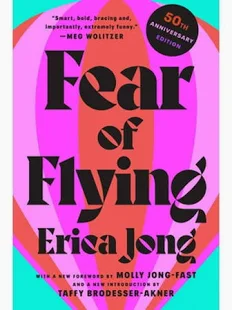
Some books become famous because of their story. Others become famous because they arrive at exactly the right moment and say something people weren’t supposed to say out loud.
Fear of Flying by Erica Jong is definitely the second kind.
First published in 1973, Fear of Flying caused a sensation with its candid portrayal of female sexuality, marriage, desire, independence, and the complicated question of what it means to actually be free. More than fifty years later, it remains a fascinating book—not necessarily because every idea has aged perfectly, but because you can still feel how daring it must have been when it first appeared.
What is Fear of Flying about?
The novel follows Isadora Wing, a 29-year-old writer and poet who travels to Vienna with her second husband, Bennett, a psychoanalyst.
Isadora is restless.
She’s married, but she’s questioning her marriage. She’s successful enough to have a life of her own, but she isn’t completely sure what she wants that life to look like. She’s constantly analyzing herself, her relationships, her fantasies, her childhood, and the expectations that have been placed on her as a woman.
Then she meets another analyst, Adrian Goodlove, and begins imagining what life might look like if she simply stopped being sensible.
What follows is part relationship drama, part sexual awakening, part travel story, and part very long internal conversation about freedom.
And Isadora has a lot of internal conversations.
A book about sex—but also about much more
Fear of Flying became notorious for its frank discussion of sex, and that’s still probably the first thing many people associate with the book.
But reducing it to a “sexy novel from the ’70s” misses what makes it interesting.
Underneath all of that is a woman trying to figure out whether the life she has chosen is actually the life she wants.
Isadora wants love but doesn’t want to disappear inside a relationship. She wants independence but is frightened by what true independence might require. She fantasizes about throwing away expectations while simultaneously worrying about what will happen if she actually does.
That contradiction is where the book feels surprisingly modern.
Freedom sounds wonderful until you realize freedom also means being responsible for your own choices.
Isadora Wing is wonderfully imperfect
Isadora isn’t written to be an idealized heroine.
She’s funny, selfish, insecure, observant, impulsive, intellectual, dramatic, and occasionally exhausting.
In other words, she feels human.
One of my favorite things about the novel is that Jong allows her female protagonist to be messy. Isadora doesn’t need to be admirable in every chapter. She can make questionable decisions. She can contradict herself. She can want two completely different things at the same time.
Considering when the book was published, giving a woman that much interior complexity was part of what made it so provocative.
Reading Fear of Flying more than 50 years later
Reading a controversial older novel is always interesting because you’re really reading two books at once.
There’s the story itself.
And then there’s the historical artifact.
Some elements of Fear of Flying don’t feel nearly as shocking today as they would have in 1973. Other parts have aged awkwardly. There are attitudes, language, and relationship dynamics that can feel very rooted in their era.
But that’s also part of the reason I think the book is still worth reading.
You get a glimpse of what conversations about marriage, feminism, sexuality, and women’s independence looked like during a period when those ideas were changing rapidly.
Things we may now take for granted were once radical enough to create a publishing phenomenon.
The famous “zipless” idea
It’s almost impossible to talk about Fear of Flying without mentioning the phrase the novel made famous: the “zipless” encounter.
Isadora imagines a completely uncomplicated sexual experience—no expectations, no emotional consequences, no obligations and no future awkwardness.
Of course, the fantasy says as much about Isadora’s desire for freedom as it does about sex.
She doesn’t just want an affair.
She wants, at least temporarily, to escape all the complicated attachments and expectations that come with being a wife, daughter, lover, and woman.
The irony is that uncomplicated freedom turns out to be much harder to find than she imagines.
What I liked
The strongest part of Fear of Flying is Isadora’s voice.
Erica Jong writes her with humor and an almost relentless level of honesty. The book is filled with thoughts that are vain, embarrassing, insightful, ridiculous, intelligent, and deeply vulnerable—sometimes all on the same page.
I also loved the larger question running through the novel:
What does freedom actually look like once you’re the one responsible for creating it?
That’s a question that hasn’t aged at all.
What might not work for every reader
This is not a particularly tidy novel.
There are long stretches of introspection, memories, fantasies, literary references, and psychological analysis. If you’re looking for a fast-moving plot, you may occasionally wonder when everyone is going to stop analyzing themselves and just do something.
The characters can also be frustrating.
But I think some of that frustration is intentional. Fear of Flying isn’t really offering a blueprint for the liberated life. It’s showing someone stumbling around trying to figure out what liberation means.
Who should read Fear of Flying?
I’d recommend this one if you enjoy:
- Feminist literary fiction
- Books about complicated marriages
- Flawed female protagonists
- 1970s cultural history
- Novels about identity and independence
- Classics that were genuinely controversial when they were released
- Character-driven books with lots of internal dialogue
If you enjoyed books like The Bell Jar, The Women’s Room, or other novels exploring women’s interior lives and changing expectations during the twentieth century, Fear of Flying is worth adding to your list.
Final thoughts
Fear of Flying isn’t a perfectly preserved feminist time capsule, and I don’t think it needs to be.
It’s messy.
It’s provocative.
It’s funny.
It’s occasionally dated.
And underneath all of it is a woman asking a question that still feels incredibly familiar:
How much of my life have I chosen for myself, and how much have I chosen because it’s what I’m supposed to want?
More than fifty years after Erica Jong first introduced readers to Isadora Wing, that’s still a pretty good question for a novel to leave behind.